Last week, when we were walking up to the top of Monteluco for the CCM concert in the woods, two guys passed us with bottles of wine. I commented on it and the speed at which they were walking- youth. On the way down, after the concert, they struck up a conversation with us. Because we've been around a lot, they asked how we were involved.
We explained and when I spoke of getting involved with Charleston's Sister City program, I mentioned that I was part of my hometown's sister city as well. Then Temecula came up. We discovered that one of the guys, Adrian, is from the town next to ours, Murrieta. Through more discussing, Adrian realized he was in an elementary class with Steve's nephew. We also found out that he will be studying in Barcelona at the same time we will be there so we've made plans for tapas in October.
Just when I thought the world couldn't get any smaller, later that night, I screamed from the shower, "Adrian is Evan's brother!" Evan is a childhood friend of my really good friend, Brady (who was just here in June and whose wedding I was in last August). She had shared enough about Evan's talented brother that I had an epiphany! So today he had an American brunch on our Italian terrace and we all delighted in our new friendships.
There is just one moon and one golden sun And a smile means friendship to everyone. Though the mountains divide And the oceans are wide It's a small, small world!
We began our day with Adrian in the Gothic Quarter, the center of the old city of Barcelona. Despite several changes undergone in the 19th and early 20th century, many of the buildings here date from Medieval times. The Barri Gòtic retains a labyrinthine street plan, with many small streets opening out into squares.
We came here to see a shop I had read about in the airline magazine- El Ingenio. Rumor has it that El Ingenio was Salvador Dalí's favorite store and after a quick peek inside, that sounds about right. As you enter the antique storefront, we were transported to a circus of color and magic. Since 1830 this small workshop has been dedicated to paper-mâché sculpting. It has been a classic for costumes, puppets, carnival masks and gadgets for all ages. The gigantic paper-mâché heads are the stars of local fiestas and parades.
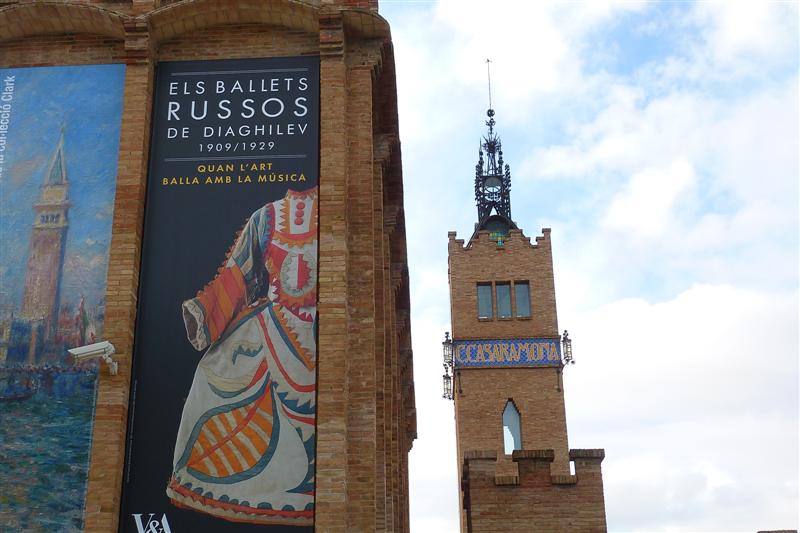
We then went to CaixaForum Barcelona Social and Cultural Center for their exhibit on the Ballets Russes (1909-1929), created by Diaghilev (1872- 1929) dictator, devil, charlatan, sorcerer, charmer was a man whose unique character and driving ambition caused a ferment in European culture. His greatest achievement was his dance company. Created a century ago, the productions of the Ballets Russes revolutionized early 20th-century arts and continue to influence cultural activity today. This exhibit was amazing with costumes, illustrations, programs, film footage and in-depth history.
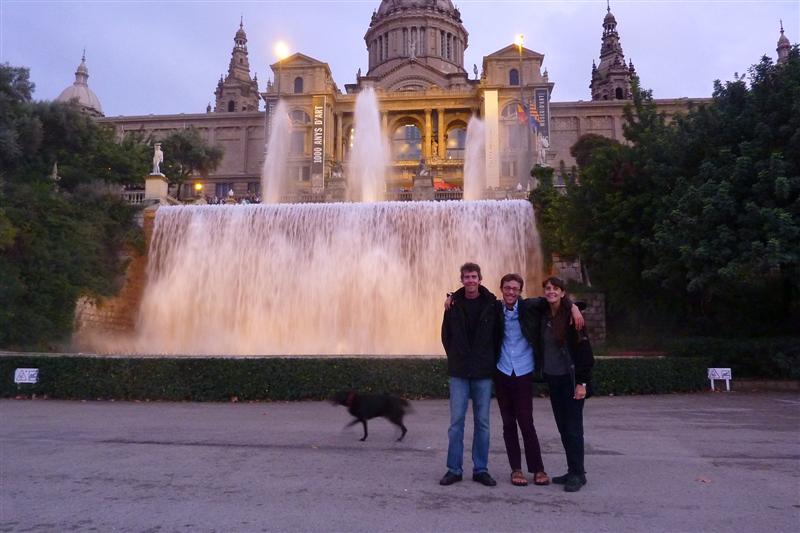
After a day of many miles of walking we concluded our touring at the magic fountain of Montjuïc (first performed in 1929 during the Great Universal Exhibition). The magic fountain is a spectacular display of color, light, motion, music and water acrobatics - if you mix all these elements together in just the right combinations, you end up with pure magic! This "show" is on most top ten of "must sees" in Barcelona. Adrian has been here for almost a month and this was his first time seeing it. Truly magical.
We then returned to our hotel for a bottle of Umbrian wine we had brought from Spoleto. It was the perfect way to end our visit and say "see you soon" to Adrian. Tomorrow we board our ship to head home. What an adventure!
Yesterday was one of blue skies and warm sunshine. What a difference a day makes... the blustery rain did not stop us from meeting Adrian for lunch and then strolls around town (we met him in Spoleto but he's from home http://haerr.blogspot.com/search?q=adrian). He is here studying viola under an exceptional maestro and we all planned to connect again when we returned to Barcelona.
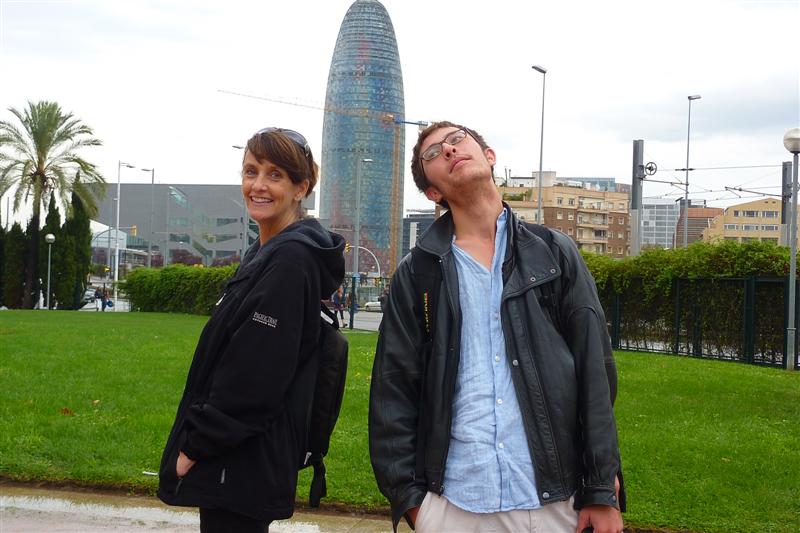
The unique structure standing very erect between us is a recent addition to the Barcelona skyline- the Torre Agbar. It was built in 2004 and is 474 ft high with 4400 windows. It was designed by French architect Jean Nouvel, The tower has 33 floors of offices and is called Agbar Tower, because it was built to consolidate the offices of the Agbar company, who occupy the top half of the building.
The architecture here continues to impress us. One of our favorite architects is someone we just "met". Enric Sagnier i Villavecchia (1858-1931) is one of the most outstanding Catalan architects from the late 19th and early 20th century. His work is the reflection of a period of great transformations, the result of the enterprising spirit of the bourgeoisie.
All through town we see his work and those of many others. It is a treasure hunt and we keep finding riches.
Fashion and discounts are two of my favorite things so when Steve discovered that Wednesdays after 5 PM were ½ off nights at our local art museum, we were in. The draw was also the incredible special exhibit, Alexander McQueen: Art Meets Fashion.
A little museum history first. The Musée national des beaux-arts du Québec (National Museum of Fine Arts of Quebec), abbreviated as MNBAQ, opened as the Musée de la province de Québec in 1933. The museum was a provincial archives, arts, and natural science museum until 1962, when the natural science collection was removed. The museum was renamed the Musée national des beaux-arts du Québec in 2002.
We were here for the first Canadian exhibition of the work of the renowned British designer, Lee Alexander McQueen (1969-2010) . A major figure in the fashion industry between 1990 and 2010, Alexander McQueen was both a technical and conceptual virtuoso. Critically acclaimed, his collections reflect his great expertise in the design and manufacture of clothing. His creative process is rooted in both autobiographical and encyclopedic references, nourished by history, natural sciences, technology, media and popular culture.
This exhibition highlights the universality of the themes – life, death, nature, mythology, religious belief systems, the human condition, etc. – which are at the heart of Alexander McQueen's artistic approach and explore the interdisciplinarity that defined the career of this internationally renowned creator.
It isn't just the fashion that makes this particular exhibition so exceptional, it's the unique associations with art pieces. Organized by the Los Angeles County Museum of Art (LACMA) , in collaboration with the MNBAQ, the exhibition consists of 69 McQueen outfits, 50 works of art from the LACMA art collection including a selection of historical costumes, 17 headdresses and shoes made by Los Angeles artist Michael Schmidt, as well as 32 artworks from the MNBAQ collection. Wow.
"The inclusion of Turkish Lord with Hounds (1923) in the MNBAQ collection is surprising, to say the least. The painting's theme aligns with the nineteenth-century French affinity for Orientalism, a fad that gained little traction among Québec artists. The lord is nevertheless sumptuously attired, and Gaston Hoffmann's idealized vision complements McQueen's interpretation of Middle Eastern garments."
"I like the concept of dressing people.
I used to not care whether people bought the clothes or not,
but I kind of like it now.
I wouldn't label that commercialism;
it's more like I do this work because
I want people to wear it."
-Alexander McQueen
How cool are these boots? They look like shoes on legs but the entire thing is a boot. They are from his Fall/Winter 2004-5 Pantheon ad Lucen collection.
"This checkerboard suit from Scanners flaunts Alexander McQueen's advanced cutting abilities: curved or squared, on the grain or bias, the pattern pieces are meticulously arranged to create a vibrant optical illusion, visually sculpting the body. His technique-first honed during Savile Row apprenticeships--can be compared to that of renowned American designer Gilbert Adrian, who similarly excelled in the graphic pattern placement of tailored suits. Both designers are noteworthy for beautifully translating traditional men's tailoring approaches for womenswear."
"It's a new era in fashion - there are no rules.
It's all about the individual and personal style,
wearing high-end, low-end, classic labels,
and up-and-coming designers all together."
-Alexander McQueen
Good Night Darthy (2006) by BGL was an interesting art pairing. This painted aluminum and plastic piece is a reference to "waste and overconsumption. The sculpture points out that Darth Vader, the mythical figure of sci-fi movies, a hybrid of man and machine, is also an object of the overconsumption that feeds pollution, as are all mass-market plastic action figures."
"The bullfight, or corrida, inspired McQueen's Spanish-influenced The Dance of the Twisted Bull (Spring/Summer 2002 collection). Interpreted by the designer as both masculine and feminine, the costume of the male matador informed the collection's silhouettes, with accents drawn from the traditional dress of female flamenco dancers. Tailored angles and draped ruffles blend in a collection that explores bullfighting's undercurrent of eroticism and death."
This display was paired with Pablo Picasso's La Tauromaquia, o arte de torear (The Art of the Bullfight).
I've included this video view of the exhibit, just to give you an even greater example of the uniqueness of all that was presented here. We knew nothing about the designer/man Alexander McQueen but now we feel we've had a thorough introduction and enjoyed it, too.
Alexander McQueen said, "I'm interested in designing for posterity." After viewing this amazing exhibit, he far surpassed his goal.






%20(Medium).jpg)

%20(Medium).jpg)
%20(Medium).jpg)
%20(Medium).jpg)
%20(Medium).jpg)
%20(Medium).jpg)
%20(Medium).jpg)
%20(Medium).jpg)
%20(Medium).jpg)
%20(Medium).jpg)
%20(Medium).jpg)
%20(Medium).jpg)
%20(Medium).jpg)
%20(Medium).jpg)
%20(Medium).jpg)
%20(Medium).jpg)
%20(Medium).jpg)
%20(Medium).jpg)

%20(Medium).jpg)
%20(Medium).jpg)
%20(Medium).jpg)
%20(Medium).jpg)
%20(Medium).jpg)
%20(Medium).jpg)
%20(Medium).jpg)
%20(Medium).jpg)
%20(Medium).jpg)
%20(Medium).jpg)
%20(Medium).jpg)
%20(Medium).jpg)
%20(Medium).jpg)
%20(Medium).jpg)
%20(Medium).jpg)
%20(Medium).jpg)
%20(Medium).jpg)
%20(Medium).jpg)

%20(Medium).jpg)
%20(Medium).jpg)
Recent Comments